
Condensation after replacing your windows: is it normal?

After replacing windows, mist can appear on the glazing or traces of moisture can form on certain walls. The new windows are then quickly suspected of being faulty or of "producing moisture".
A common explanation is, however, different: the new windows are far more airtight than the old ones. They eliminate the uncontrolled infiltration that previously contributed, at random, to the renewal of the air.
The water vapour produced in the home must now be removed by organised ventilation. If this is insufficient, moisture can condense on the glazing or on other cold surfaces.
But not all traces of water are normal. Their location and the moment they appear help to distinguish a ventilation problem, harmless exterior condensation, a faulty glazing unit or genuine infiltration.
Why does condensation appear?
Indoor air naturally contains water vapour. The occupants breathing, showers, cooking and drying laundry produce it every day.
When this humid air meets a surface whose temperature is low enough, the vapour turns into droplets. This threshold temperature is called the dew point.
The risk of condensation therefore increases when:
indoor humidity is high
ventilation is insufficient
certain surfaces stay very cold
heating is irregular
thermal bridges are present
air circulates poorly in certain areas
Why can the phenomenon appear after the work?
Old windows often let air through at the seals, the sashes or the joints with the façade. These leaks cause draughts and heat loss, but they also allow some moisture to escape.
After their replacement, this unintended ventilation disappears. This is a significant improvement for comfort and energy performance, provided the home has suitable air renewal.
The new windows do not therefore create the moisture. They change the building’s balance: humid air no longer escapes through their gaps in the seal.
This does not necessarily mean that the home already had a serious moisture problem. Vapour production may be identical, but its removal has become insufficient since the airtightness improved.
Three locations of condensation, three diagnoses
1. Condensation on the inner face of the glazing
This mist is on the room side and can be wiped from inside. It often appears in the morning in bedrooms, after a shower or while preparing meals.
It usually reflects a combination of:
high indoor humidity
insufficient ventilation
a low outdoor temperature
an inner glazing surface that is still cold
insufficient or irregular heating
A slight, occasional mist can occur under certain conditions. If it is abundant, daily or accompanied by mould, its cause must be sought.
Interior condensation is not in itself considered a fault of the glazing. However, an abnormally low temperature around the frame or the joint with the wall may justify a check of the fitting.
2. Condensation on the outer face of the glazing
Mist can also appear on the outer face, generally early in the morning after a cold, clear night.
With high-performance insulating glazing, little indoor heat reaches the outer pane. It can then become cold enough for the moisture in the outside air to condense on it.
This phenomenon:
appears on the outside
is often temporary
depends on the weather and the orientation
disappears as the temperature rises
is generally not a fault
Exterior condensation is in fact compatible with very good thermal insulation of the glazing.
3. Condensation between the panes of glass
When the mist is inside the insulating glazing unit and cannot be wiped away from either inside or outside, the diagnosis is different.
It generally indicates that the perimeter seal of the double or triple glazing is no longer airtight. Moisture has entered the normally sealed space between the panes of glass.
Once the fault is confirmed, it is usually the insulating glazing unit that needs to be replaced. Replacing the whole frame is not necessary if it remains in good condition and can take a new compatible glazing unit.
Condensation or water infiltration?
A damp trace that appears after the windows are replaced is not always condensation.
Condensation forms mainly when humid air meets a cold surface. It is often linked to temperature, occupancy of the home and ventilation.
Infiltration is more likely suspected when the moisture:
appears during or just after rain
stays concentrated near the sill, the lintel or a side joint
develops independently of how the room is used
is accompanied by traces in the plaster
follows a seal or a junction between the frame and the façade
In this case, you must check the sill, the exterior seals, the drainage, the sealing membranes and the joints between the outer frame and the building.
Adding a vent or airing more will not solve infiltration. Conversely, redoing an exterior seal will not correct a general indoor moisture problem.
Ventilation becomes essential
A home must renew its air to remove moisture, carbon dioxide and indoor pollutants.
With high-performance windows, this renewal must no longer depend on uncontrolled leaks. It must be provided by a solution designed for the purpose:
integrated vents or air inlets
extractors in wet rooms
mechanical ventilation
an existing ventilation system correctly set and maintained
air inlets and outlets that are consistent with one another
The choice depends on the type of home and the existing system. A ventilation grille should not be added automatically to every window: its position and airflow must be consistent with how the ventilation works overall.
This question should ideally be studied before ordering the new windows.
Wall insulation also comes into play
Moisture condenses first on the coldest surfaces.
If the new glazing becomes warmer on the inside, but some walls remain poorly insulated, the coldest point can shift towards:
an external corner
a north-facing wall
the perimeter of the window
a lintel
a junction between the wall and the floor
another thermal bridge
Stains or mould can then appear on these areas.
The comfort of a home must therefore be approached as a whole: frames, glazing, insulation, ventilation, heating and quality of fitting form a single system.
How to reduce interior condensation?
Use ventilation correctly
Leave the provided air inlets open and check that the extractors are working. Ventilation openings must stay clean and not be hidden behind furniture.
Remove moisture at its source
Use the extractor hood while cooking. A recirculating hood mainly filters grease and odours, but does not necessarily vent the vapour outside.
After a shower, run the extraction or air the bathroom.
Air the home intensively
When the home lacks sufficient air renewal, open the windows wide for a short period rather than leaving a sash ajar for hours.
This airing is a useful supplement, but does not always replace permanent, correctly sized ventilation.
Limit drying laundry indoors
If it is unavoidable, choose a properly ventilated room and remove the moisture produced.
Keep a relatively steady temperature
A very cold home has more surfaces likely to reach the dew point. Regular heating reduces this risk, without on its own solving a ventilation or insulation defect.
Monitor humidity
A hygrometer lets you observe how relative humidity changes across rooms and activities. A single reading is not enough to establish a diagnosis, but persistently high values are a useful indicator.
Wipe away any water present
While waiting to resolve the cause, remove the droplets on the glazing and sills to protect the seals, paintwork and finishes.
When should you request a diagnosis?
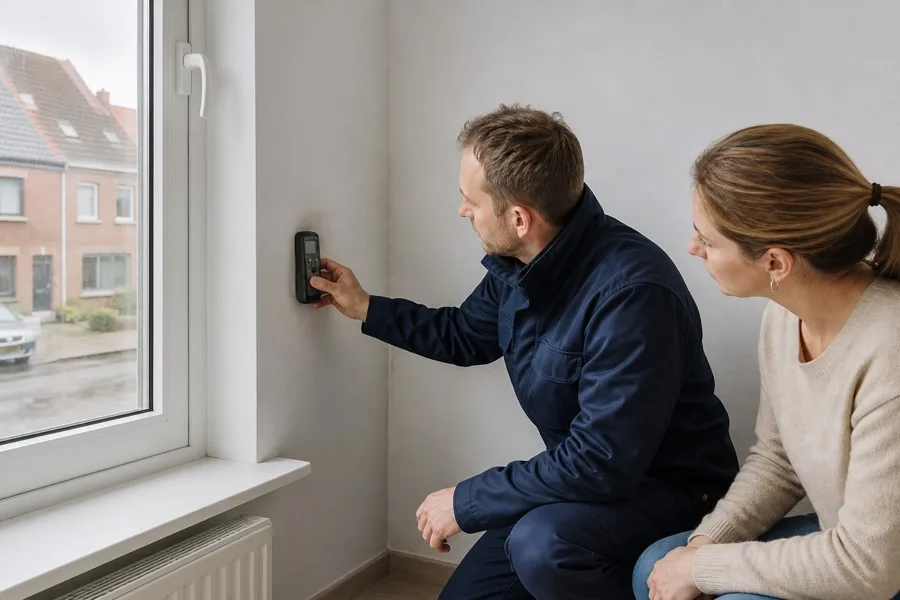
A check is advisable when you notice:
abundant, daily interior condensation
water accumulating at the bottom of the glazing
mould on the walls or around the frame
localised moisture after rain
mist between the panes of glass
a particularly cold area around the frame
a problem limited to a single room or a single window
a persistent smell of damp
a phenomenon that appeared immediately after the work and is not decreasing
The diagnosis must determine the origin of the problem before any intervention: ventilation, use of the home, thermal bridge, fitting joint, infiltration or glazing fault.
Frequently asked questions
Does exterior condensation mean the glazing is faulty?
No. When it forms on the outer face and disappears as the weather changes, it generally results from the cooling of well-insulated glazing.
Does triple glazing prevent all condensation?
No. It can reduce the risk of condensation on the inner face thanks to a higher surface temperature. It can, however, encourage exterior condensation. Interior humidity still depends on ventilation and how the home is used.
Do new windows have to include vents?
Not in every case. It depends on the existing ventilation system, the rooms concerned and the requirements of the project. The decision must be made before the windows are manufactured.
Can a new window still be responsible for moisture?
A window does not produce moisture. However, a faulty glazing unit, a poorly executed joint, an insufficiently sealed sill or a thermal bridge around the frame can contribute to a localised problem.
Is opening the windows enough?
Full, regular opening can help, but it does not always guarantee the air renewal needed throughout the day. In a very airtight home, organised ventilation remains the most reliable solution.
Conclusion
Condensation after replacing your windows does not automatically indicate a fault with the new windows. It often results from a home that has become more airtight without a sufficient adaptation of the ventilation.
Its location remains decisive: interior mist calls for a check of humidity and ventilation, exterior condensation is generally harmless, while mist between the panes indicates a fault in their seal. Moisture appearing after rain may, for its part, signal infiltration.
At Pulsar Windows, we examine the ventilation, the glazing and the fitting joints as early as the study of the project. Measuring and installation are carried out exclusively by our own team, with no subcontracting.
Request your free, no-obligation quote in Brussels, in Flemish Brabant or in Walloon Brabant.
A window project?
Tell us about your project to receive a tailored proposal.