
Painting PVC windows: why it is generally not recommended

Want to modernise your façade or match your windows to a new decor? Repainting PVC windows can seem simpler and cheaper than replacing them.
Technically, the operation is possible in certain situations. It requires, however, rigorous preparation, compatible products and regular maintenance. Ordinary paint applied directly to PVC risks giving a fragile result and can harm the proper working of the window.
Before reaching for the brushes, it is therefore better to understand the constraints and examine the solutions specifically designed to colour PVC joinery.
Can you really paint a PVC window?
The short answer is: yes, but not like a wall or wooden joinery.
PVC has a smooth, low-porosity surface to which traditional paints adhere with difficulty. To obtain an acceptable result, you must identify the existing finish, prepare the substrate correctly, apply a compatible primer and choose a paint suited to the material’s movements.
Window manufacturers may, moreover, formally advise against this intervention. Before any work, it is therefore essential to consult their recommendations and check the possible consequences for the guarantee.
1. A surface that offers little adhesion
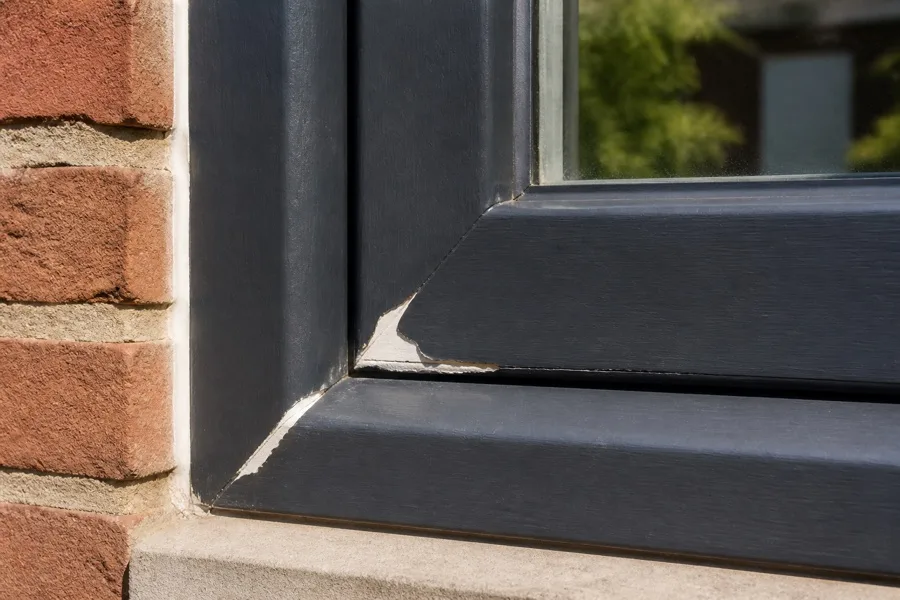
PVC is valued because it holds little dirt and cleans easily. This smooth surface, however, becomes a drawback when you want to paint it.
Without suitable preparation, the paint can:
adhere unevenly
show brush marks
peel at the corners
flake after an impact
deteriorate in contact areas
gradually lose its appearance under the effect of UV and the weather
A simple clean is therefore not enough. The substrate must be clean, dry and degreased. Light matting and a primer specifically compatible with PVC are generally necessary.
These operations themselves carry a risk: sanding that is too aggressive can permanently scratch the profile, while an unsuitable solvent can attack its surface or its decorative foil.
2. Preparation that is far more demanding than it looks
The quality of the result depends mainly on the preparation. You must protect the glazing and carefully mask the elements that should receive no paint.
Particular attention must be paid to:
the weatherseals
the handles and hardware
the hinges
the drainage holes
the water-drainage grooves
the surfaces that touch when closing
useful technical labels and markings
A build-up of paint in a contact area can hinder the closing of the sash. Paint deposited on the seals can also cause them to stick or accelerate their degradation.
If the drainage openings are blocked, water can no longer be drained away correctly. It is therefore not the paint itself that automatically changes the performance of the window, but a poor application can disrupt certain elements essential to its operation.
3. Dark colours can cause overheating
PVC expands and contracts under the effect of temperature variations. A dark colour absorbs more solar radiation than a light surface.
Painting an old white profile black or very dark grey can therefore significantly increase its temperature, particularly on a façade heavily exposed to the sun.
This temperature rise can amplify the movements of the frame and lead to:
stresses at the joints
a warping of the profiles
difficulties opening or closing
a maladjustment of the sash
uneven pressure on the seals
in unfavourable cases, a degradation of the seal
The risks depend on the profile system, its reinforcements, its dimensions and its exposure. A dark colour offered directly by the manufacturer normally relies on a combination of materials and treatments studied for this use. This is not necessarily the case for a coat of paint added later.
4. The finish requires regular maintenance
One of the usual advantages of PVC is that it needs no repainting. Once repainted, the window partly loses this ease of maintenance.
The new finish will have to be monitored and possibly touched up in case of:
scratches
impacts
flaking
loss of adhesion
discolouration
wear in contact areas
The edges and corners are particularly sensitive, as the layer of paint there is generally thinner.
The build-up of several coats over successive maintenance can also reduce the clearances designed between the elements and hinder closing. It then becomes necessary to remove or locally sand the old coats, which remains delicate on PVC.
5. Going back is difficult
A poorly applied paint cannot always be removed without damaging the substrate.
The methods commonly used on wood or metal do not necessarily suit PVC:
a chemical stripper can attack the material
a heat gun risks warping it
aggressive sanding can leave deep scratches
some solvents can damage a foiled finish
It is therefore wise to consider painting as a hard-to-reverse intervention.
6. The guarantee must be checked
The conditions vary according to the manufacturer, the profile system and the original finish. An unplanned modification or one carried out with unapproved products can complicate the handling of a later problem.
Before any intervention, ask for written confirmation regarding:
the compatibility of the paint with the profile
the authorised preparation
the accepted colours
the recommended products
the possible consequences for the guarantee
This precaution is particularly important for recent windows.
Is professional painting possible?
In some cases, a specialist company may consider repainting a PVC window. It will first have to examine the condition of the substrate, the existing finish, the adhesion of any decorative foil and the exposure of the window.
A serious intervention notably involves:
a full clean and degrease
a test on an inconspicuous area
very light matting if the system allows it
the application of a primer compatible with PVC
a paint that is sufficiently flexible and resistant
the protection of the seals, mechanisms and drainage
respecting the temperatures and drying times
a check of the operation after the intervention
Even when correctly executed, this finish will require more maintenance than a colour applied industrially.
Which solutions to choose for changing colour?
A coloured finish provided from manufacture
When replacing windows, the safest solution is to choose the desired colour directly.
Depending on the range, several possibilities exist:
through-body coloured PVC
decorative foil or laminated finish
wood effect
coloured coating applied industrially
a different colour inside and out
These finishes are tested with the profile system and designed to withstand UV, the weather and thermal movements.
Exterior aluminium cladding
Some PVC systems can take an exterior aluminium cladding, sometimes called AluClip.
The PVC continues to provide the insulation, while the exterior cladding offers a wide variety of colours and good resistance to weather conditions. This solution must, however, be compatible with the window model concerned.
Professional replacement of a decorative foil
On some already-foiled windows, a specialist company may be able to replace or repair the decorative covering.
This solution is different from applying an ordinary adhesive film. It must be carried out with a product intended for exterior joinery and compatible with the dimensions, angles, exposure and movements of the window.
Replacing the windows
When the windows are old, warped, poorly insulating or already damaged, investing in a repaint may not be worthwhile.
Replacement then makes it possible to choose, at the same time:
the colour
the style
the glazing
the insulation performance
the security
the ventilation
the finishes
In conclusion
Painting a PVC window is not strictly impossible, but the operation involves more constraints than it appears. Poor preparation, unsuitable paint or too dark a colour can cause cosmetic defects, recurring maintenance and, in some cases, operating problems.
For a lasting result, it is better to favour a finish provided by the manufacturer: coloured PVC, decorative foil, industrial coating or aluminium cladding.
Are you considering replacing your windows or changing the look of your façade? Pulsar Windows helps you choose a solution consistent with your home, your expectations and your budget. Request your free, no-obligation quote in Brussels or in Brabant.
A window project?
Tell us about your project to receive a tailored proposal.