
When should you replace your front door?

A front door does not necessarily have to be replaced as soon as a seal wears out or a lock becomes hard to operate. Some problems are corrected by an adjustment, a repair or replacing a part.
On the other hand, when defects multiply or concern the structure, the sealing, the insulation or the security of the whole, replacement can become the most sensible solution.
Here are the main signs to watch for.
1. Draughts persist around the door
A feeling of cold air, a slight movement of the curtain or a thread of light visible around the leaf generally signals an air-tightness defect.
Before considering a new door, you should check:
the condition of the perimeter seals
the adjustment of the hinges
the compression of the leaf against the frame
the sealing of the threshold
the joint between the frame and the masonry
If the door is still stable and in good condition, an adjustment or replacing the seals may be enough. If the leaf or the frame is warped and no longer closes evenly, replacement becomes more relevant.
2. Water or moisture appears near the threshold
Water infiltration should be examined promptly. It can come from the door, but also from the threshold, the joints with the façade, the drainage or heavy exposure to driving rain.
Recurring traces, a swelling covering or persistent moisture do not therefore automatically mean the door alone is responsible.
A diagnosis helps identify the origin of the problem and avoid replacing the joinery without treating the real cause. When the threshold, the frame and the leaf are damaged or can no longer provide a satisfactory seal, replacing the whole assembly is generally preferable.
3. The door becomes hard to open, close or lock
A door that rubs slightly can sometimes be put right with a simple adjustment. However, significant warping can prevent the locking points from engaging correctly.
You should pay attention when:
the door has to be lifted or pushed hard to close
the key turns with difficulty
the locking points no longer engage
the leaf rubs heavily against the threshold or frame
uneven gaps appear around the door
If the problem comes only from the hardware, a repair may be enough. If the frame or the door panel is warped, cracked, rotten or heavily corroded, replacement is often more durable.
4. The door shows visible damage
The signs of ageing depend on the material:
wood that is degraded or rotten deep down
a cracked or warped panel
significant corrosion
joints that are working loose
seals that are hardened, shrunken or impossible to replace properly
repeated infiltration that has damaged the frame
Superficial degradation can sometimes be repaired. But when stability, sealing or closing is affected, keeping the door risks multiplying interventions without lastingly solving the problem.
5. The entrance stays cold despite the heating
An old, poorly insulating door can create a cold-surface sensation and contribute to heat loss. The benefit of a replacement depends, however, on the condition of the existing door, the quality of the new joinery and the overall insulation of the building.
To compare products, you must look at the Ud value, which represents the thermal transmittance of the complete door. The lower this value, the better the door insulates.
It is therefore not enough to compare the thickness of the panel. Performance also depends on the frame, any glazing, the threshold, the seals and the quality of the fitting.
A new door generally improves comfort near the entrance, but the real saving on heating varies from one home to another. It is best to avoid any figures-based promise without a prior analysis of the building.
6. Outside noise passes easily through the entrance
The acoustic performance of a door does not depend on the panel alone. It rests on the assembly formed by:
the leaf
the frame
any glazing
the perimeter seals
the threshold
the joints with the masonry
A small air gap is enough to greatly reduce acoustic insulation. In some cases, replacing the seals or improving the threshold can already bring a noticeable result.
When the door is light, warped or poorly adjusted, a new door that is correctly designed and fitted can improve the quiet indoors. The level to aim for should, however, be defined according to the real noise environment.
7. The door’s security has become insufficient
An old door can still close correctly while offering limited protection. Security depends on the entire door assembly: panel, frame, lock, strike plates, cylinder, cylinder protection, hinges, glazing and fixing to the masonry.
Among the points to examine:
a lock limited to a single point
a cylinder that protrudes from the escutcheon
a weakened frame
poorly fixed hinges or strike plates
easily accessible, unsuitable glazing
excessive play between the leaf and the frame
Depending on the condition of the door, it is sometimes possible to reinforce the lock or replace the cylinder. If the structure itself is too weak, full replacement makes it possible to design more consistent protection.
8. The door no longer suits the architectural project
Replacement can also be motivated by a change of aesthetics, a façade renovation or the wish to harmonise the door with the windows and other joinery.
The material, colour, dimensions, glazing, handle and lines of the panel should be chosen to suit the style of the home. For a flat, a listed building or a visible change to the façade, it is wise to check the co-ownership rules and the applicable planning requirements before ordering.
Repair or replace: how to decide?
A repair can be enough when:
the door and frame remain stable
the problem comes from the seals or a poor adjustment
the lock or cylinder can be replaced separately
the infiltration comes from a localised, repairable joint
the damage is essentially superficial
Replacement becomes relevant when:
the leaf or frame is heavily warped
the infiltration persists after several interventions
the door shows structural degradation
closing and security can no longer be restored correctly
thermal performance is insufficient within an overall renovation
several significant defects are present at the same time
The fitting is as important as the door
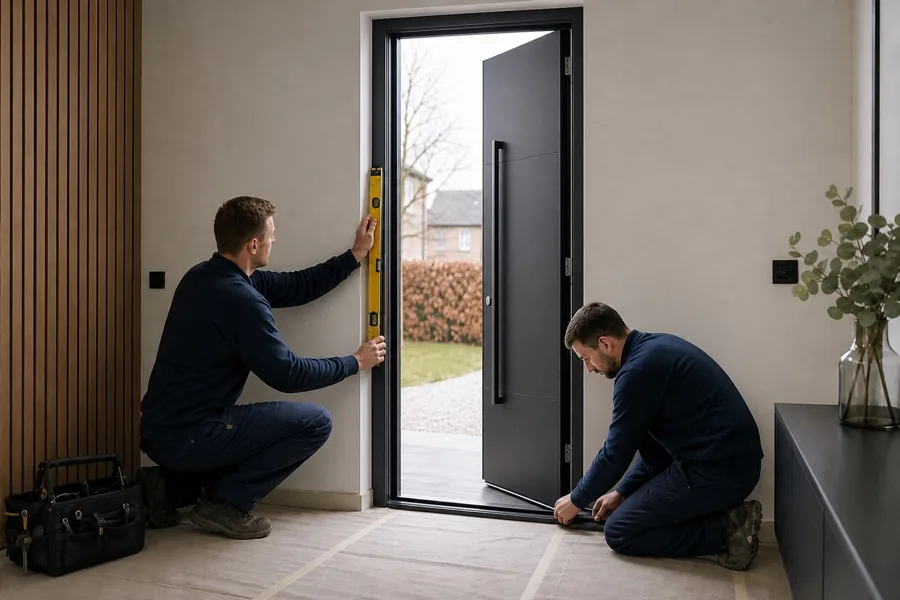
A high-performance door only delivers good results if it is correctly measured, fixed, adjusted and connected to the building.
Particular attention must be paid to air- and water-tightness, the treatment of the threshold, the perimeter insulation and the finishes. These elements directly influence the thermal comfort, the acoustics and the durability of the installation.
At Pulsar Windows, the advice, the measuring and the fitting are carried out exclusively by our own team, with no subcontracting. This lets us follow each project consistently, from the analysis of the old door to the final adjustments.
Good to know
Under certain conditions, renovation work on a private home at least ten years old may benefit from the reduced VAT rate of 6%. The rules and any regional grants should always be checked according to the situation of the building and the date of the work.
Conclusion
There is no precise age from which a front door must automatically be replaced. The decision depends on its condition, the defects observed and the real possibilities for repair.
Pulsar Windows examines your entrance and helps you choose the most sensible solution: an adjustment, improving certain components or full replacement with a bespoke door.
Request your free, no-obligation quote in Brussels or in Flemish and Walloon Brabant.
A window project?
Tell us about your project to receive a tailored proposal.